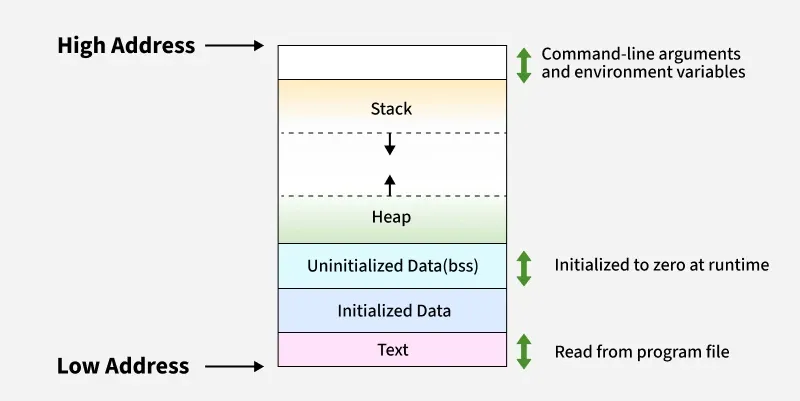
- 4가지 영역으로 구분
- stack
- heap
- data
- 초기값 있는, 없는 전역/정적 변수
- 문자열 리터럴, 읽기 전용 변수
- text
Stack Segment
- The stack stores local variables, function parameters, and return addresses for each function call.
- Each function call creates a stack frame in this segment.
- The stack is usually at higher memory addresses and grows opposite to the heap.
- When the stack and heap meet, the program’s free memory is exhausted.
-
    #include <stdio.h>

  void func() {

      // Stored in the stack
      int local_var = 10;
  }

  int main() {
      func();
      return 0;
  }
Heap Segment
- The heap segment is used for dynamic memory allocation.
- It starts at the end of the BSS segment and grows towards higher memory addresses.
- Memory in the heap is managed using functions like malloc(), realloc(), and free().
- The heap is shared by all shared libraries and dynamically loaded modules in a process.
-
  #include <stdio.h>
  #include <stdlib.h>

  int main() {

  	// Create an integer pointer
  	int *ptr = (int*) malloc(sizeof(int) * 10);
  	return 0;
  }
Data Segment
- The data segment stores global and static variables of the program.
- Variables in this segment retain their values throughout program execution.
- The size of the data segment depends on the number and type of global/static variables.
- It is divided into initialized and uninitialized (BSS) sections.
- BSS - Block Started by Symbol
Text Segment
- The text segment (or code segment) stores the executable code of the program like program’s functions and instructions.
- The segment is usually read-only to prevent accidental modification during execution.
- It is typically stored in the lower part of memory.
- The size of the text segment depends on the number of instructions and the program’s complexity.
